USC launches first-of-its-kind Bachelor of Social Work to meet high workforce need
August 28, 2026 / by Michele Carroll- Students
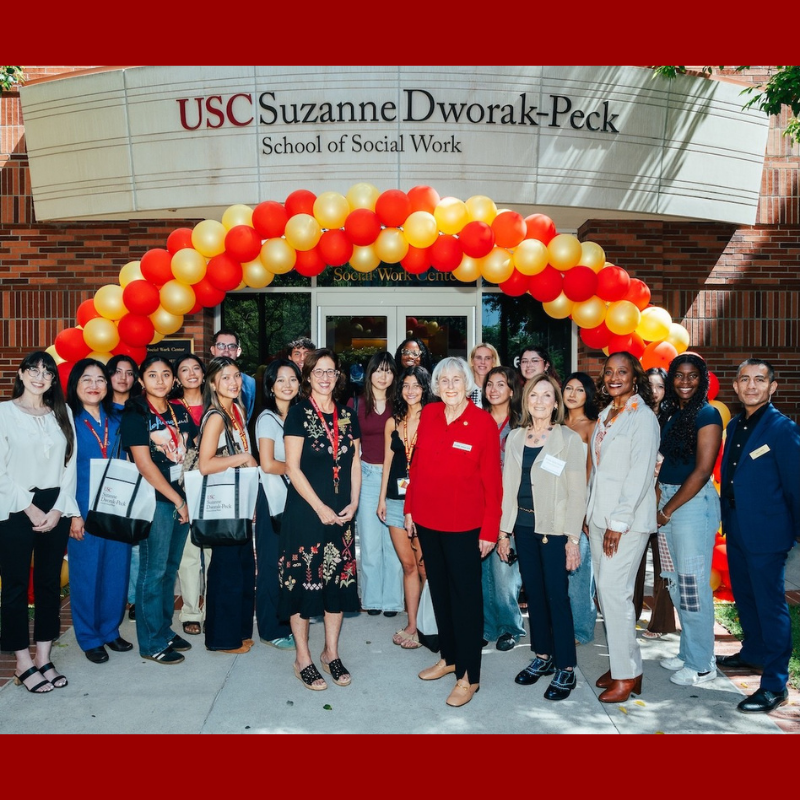
USC has launched a new Bachelor of Social Work (BSW) program, the first such degree offered by an R1 private university in California. The BSW is designed to directly address the behavioral health workforce shortage in California and support students in building meaningful careers after graduation. It is also the first undergraduate degree program offered by the USC Suzanne Dworak-Peck School of Social Work, joining the school’s undergraduate minor in Social Work in Juvenile Justice as well as its five graduate programs. Fourteen students will begin the program this fall, representing a range of both incoming and internal transfer or multiple-major students.
More than 75 people attended the program’s launch event on August 21, including students, faculty and guest speakers.
“We are so excited to offer this new undergraduate option to USC students,” said Umeka Franklin, associate teaching professor and director of the BSW program and undergraduate education. “The BSW integrates evidence-based practice and theory with real-world experience, giving students the opportunity to create change within the heart of Los Angeles even before they receive their undergraduate degree.”
Meeting the high need for behavioral health workers in California
The BSW program is funded in part by a $1.5 million grant from the California Department of Health Care Access and Information (HCAI) to address the state’s ongoing behavioral health workforce shortage. HCAI data analyses show that all 58 counties in California currently have fewer clinicians than needed. The shortage is being felt across nearly every level and role, including pre-licensed and non-prescribing clinicians and wellness coaches. By 2033, rising demand for mental health care is projected to leave California with a 42% shortfall of non-prescribing licensed clinicians, requiring nearly twice today’s workforce to meet demand.
To help meet that need, USC’s BSW program has a strong focus on skills that prepare students for the workforce, including a 440-hour practicum requirement that has students working in the social work field and gaining valuable experience before graduation.
“The new USC BSW program has been designed to prepare students to go into the real world and apply the knowledge and skills they are getting, better equipping them for the workforce,” said Omar López, teaching professor, assistant dean of workforce development, and the principal investigator for the HCAI grant helping to fund the program.
Part of the goal of this new program is to expose more undergraduate students to the discipline of social work and its many applications in the workforce earlier in their academic and professional careers. López says that the BSW program is exactly what he wishes had been available when he was an undergraduate looking for a way to apply his passion for people in society and systems in a way that would have real-world impact. It wasn’t until he was working in his first professional job towards the end of his undergraduate education that he learned about social work from a chance meeting with a social work professor.
“It literally took five minutes of someone in the profession introducing the concept of the discipline to me and I knew this was exactly what I had been looking for the whole time,” López said. “This new degree and the work experience it offers places students in the pipeline sooner, with a social work degree that has broad applications across behavioral health.”
An academic discipline that is also a career
At a time when undergraduate students report significant stress about starting their careers and half of recent graduates report that they work in jobs that do not require a college degree, Franklin points to the practical benefits of a social work degree.
“Social work is more than an academic discipline, it’s a career,” said Franklin. “When I talk to people about social work and the range of professional opportunities, they are always surprised. For example, research shows that social workers provide 70% of mental health services in the U.S.”
Some of those career opportunities include working in school settings, hospitals, government agencies, developing public policy, advocacy and leading community organizations, and as mental health providers in agencies or private practice. One of the little-known facts about the profession Franklin cites that the largest employer of social workers is the U.S. Department of Veterans Affairs (VA), supporting military personnel and veterans.
As part of the workforce readiness component of the BSW, before they even begin their external practicum, students will complete a community immersion where they will learn about the needs of the populations they will work with as well. They are also considering using an AI-powered simulation lab to allow students to practice important assessment and intervention skills virtually before working with real clients. The program also plans to offer a mandatory employment readiness course during students’ final semester, where they will hear from employers in the community about expectations and opportunities, as well as a job fair.
“They will graduate with the degree as well as the experience,” said Franklin. “They will have this on their resume to be able to really showcase the skills that they’ve learned and have been able to apply.”
López also points out that the program holds appeal for high-achieving USC undergraduates who often pursue a second or even third major, in order to add applied knowledge and experience to other disciplines they are studying. For those considering graduate education, the advanced standing Master of Social Work (MSW) offered by USC Social Work allows those who have completed a BSW accredited by the Council for Social Work Education (CSWE), which the USC BSW is currently pursuing, to complete their masters in as little as one year.
“The BSW is an opportunity for our undergraduates at USC to get ready for the workforce,” López. “Not only are they going to get evidence-based theory, they are concurrently going to be applying it in the real world, and that's where the rubber meets the road.”
To reference the work of our faculty online, we ask that you directly quote their work where possible and attribute it to "FACULTY NAME, a professor in the USC Suzanne Dworak-Peck School of Social Work” (LINK: https://dworakpeck.usc.edu)